
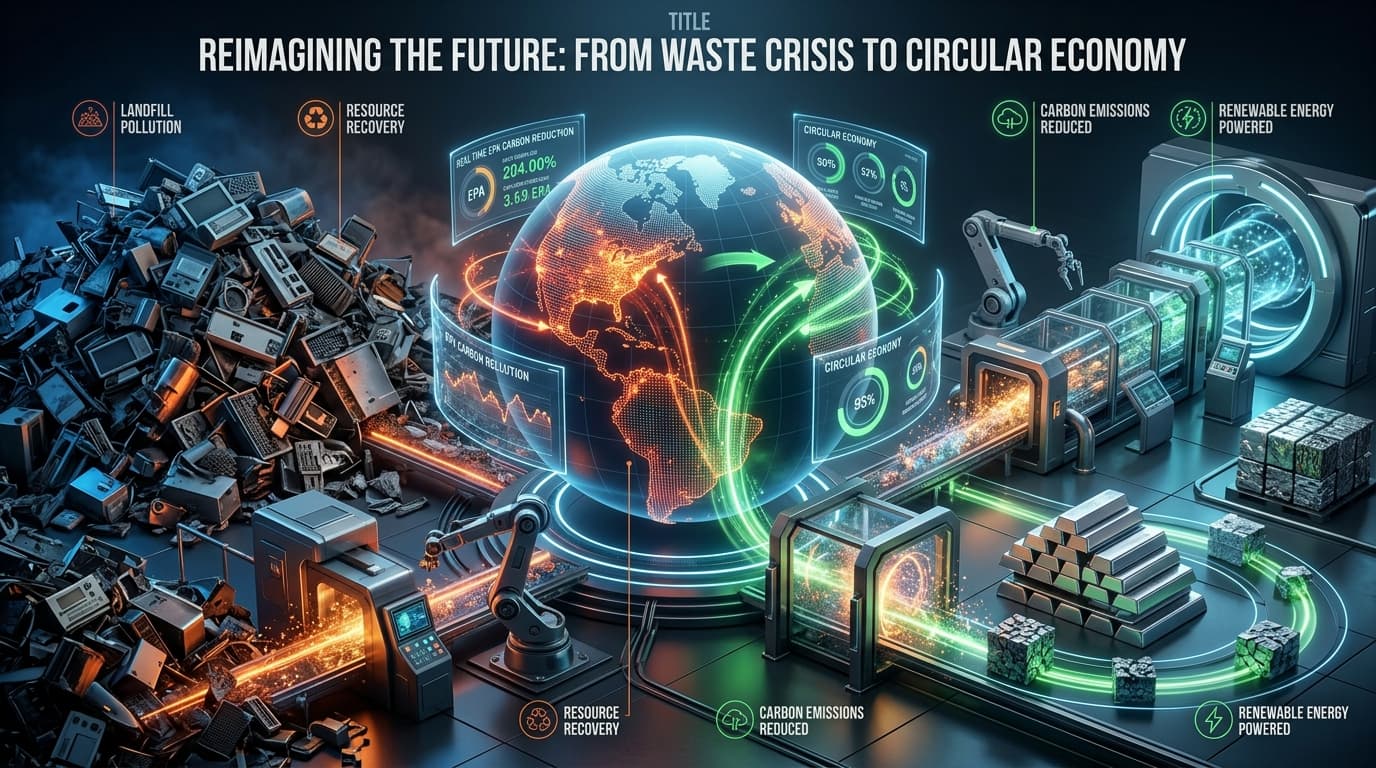
Global Waste vs Virgin Metal Extraction: The Energy Imbalance
Every year, human civilization extracts over 100 Billion metric tons of raw primary resources from the Earth’s crust. Mining virgin bauxite for primary aluminum consumes over 14,000 kWh of electric energy per metric ton and generates massive open-pit red mud tailing ponds that poison regional water tables.
In contrast, remelting secondary aluminum scrap requires 95% less energy (only ~700 kWh/MT) and prevents 9.13 metric tons of greenhouse gas emissions per ton recycled. Yet despite this overwhelming physical advantage, more than 60% of recyclable metal and engineering plastics in developing economies are lost to landfills, open dumps, or crude backyard burning.
Why the Current Linear Recycling System Is Broken
1. Informal Opacity & Predatory Middleman Arbitrage
India’s 5 Million waste pickers collect up to 150 kg of scrap daily. Because they lack access to real-time commodity indices (MCX / LME), local aggregators impose arbitrary 30% to 45% moisture, dust, and tare weight deductions. Collectors are paid in untraceable cash at a fraction of true value, trapped in generational debt cycles.
2. $12.4 Billion Global ESG Greenwashing & Fake PDF Certificates
Over 40% of Extended Producer Responsibility (EPR) credits traded across South Asia represent fictitious recycling volume ("paper round-tripping"). Intermediaries generate fake invoices for scrap that was never actually collected or smelted, allowing polluting multinationals to claim net-zero compliance on paper while real waste fills waterways.
3. GenAI Carbon Math Hallucinations in Enterprise Software
Generic generative AI models hallucinate carbon offset calculations because they lack physical life-cycle boundary conditions. CircularChain replaces stochastic LLM outputs with deterministic EPA WARM v15 life-cycle equations tied directly to verified digital weighbridge mass.
4. Massive CPCB Statutory Compliance Fines (FY 2026-27 Mandates)
Under the Plastic Waste Management Rules 2026 and E-Waste Rules 2022, brand owners must fulfill mandatory recycling quotas (70% in FY 25-26, 80% in FY 26-27). Non-compliance triggers non-negotiable Environmental Compensation (EC) penalties of up to ₹25,000 per MT under Central Pollution Control Board statutory audits.